What is radon? In short, it is a radioactive gas that can
cause lung cancer with long-term exposure. It is the main cause in
non-smokers and a major risk factor for smokers. Over 21,000
radon-related deaths are estimated in the US per year. That's more than
drunk driving, over five times more than drowning, and almost ten time
more than fire. Radon naturally occurrs in Wisconsin and all over the
world as Uranium-238 decays in the soil.
This process will continue essentially until the end of time; U-238 has
a half-life of 4.5 billion years. Invisible and odorless, radon can
only be detected with specialized equipment. It enters buildings and
gathers much higher concentrations than there is outdoors. Any home or other building can have a high radon levels, especially in Wisconsin. It's worth testing your home, and if you do have a problem, it's worth fixing.
We recommend homeowners or real estate agents begin by reading the EPA's Citizen's Guide to Radon or Home Buyer's and Seller's Guide to Radon. They're short and very informative. Here is some additional Q&A.
|
What is a good radon level?
It's
important to put numbers in perspective. Strictly speaking, there is no
known safe amount. 0.4 pCi/l is the average for outdoor air; the
average concentration could vary with the weather and in different
areas. You're not likely to have less radon indoors than outdoors. 4
pCi/l is a high level that should be fixed, according to standards
organizations (IEA/AARST, NRPP, EPA). Between 2 and 4 pCi/l, it's
recommended to consider fixing. 2 pCi/l or less is a good result. For many buildings that is as low as reasonably achievable.
Airborne radon exposure is understood with a linear no-threshold model. Risk
is proprtional to exposure concentration times exposure duration. It's
good to lower your exposure at home or where you spend the most time.
Is radon real?
We've
been asked by some who are skeptical as they go through the testing and
mitigation process while selling their homes. That's understandable
since humans don't directly experience radon with our five senses. It
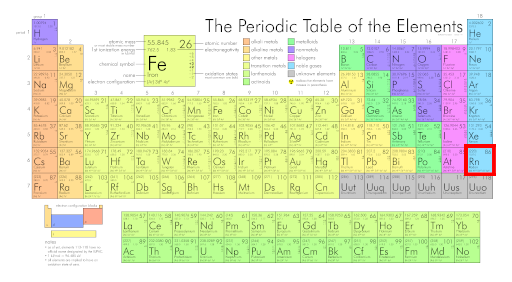
is definitely real, being the 86th chemical element and the heaviest
noble gas. Like the others, helium, neon, argon, and xenon, it is
colorless, odorless, and chemically inert. Unlike the lighter noble
gases, all isotopes of radon are radioactive. It was discovered in 1899
and is well-studied today. We measure it ourselves regularly.
How can it cause cancer?
After breathing in radon or products of its decay, ionizing radation is
released inside the lungs. Even alpha radiation too weak to penetrate
skin can affect lung tissue from inside. Cells with a damaged genetic
code may then become cancerous.
|
|
Is there a particular concern in Wisconsin?
Yes, based on public information and our own measurements throughout the state. The EPA radon map shows moderate to high levels. The Fox Valley has a high concentration of uranium according to the US Geological Survey.
The maps match well! However, we've worked all over including the lower
uranium areas. Our long heating season contributes to radon averages.
Levels tend to be highest when it's coldest. Hot air rising from
buildings is replaced by air from underground. Radon has plenty of time
to decay inside a closed-up building with a slow air change rate.
Should I bother testing if my neighbors have low radon or if I live in a low radon area?
There's no substitute for testing your own home. In the course of
testing whole subdivisions, we've seen great variations between
next-door neighbors. These were new buildings with seemingly identical
construction. Averages of a neighborhood are not enough to predict an
individual home's level, let alone averages of states or counties.
|
|